Target Derived Data
Higher-order data products related to the target of observation
Primary
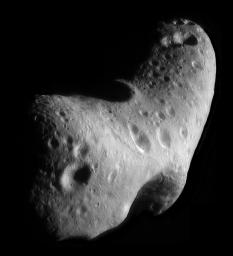
433 Eros
433 Eros is an S-type asteroid that was discovered on Aug. 13, 1898 by Gustav Witt, director of the Urania observatory in Berlin, and independently on the same day by Auguste H.P. Charlois at Nice, France. It is the largest of the near-Earth asteroids, with dimensions 34.4 × 11.2 × 11.2 km, and an orbit semi-major axis distance of 1.4576 AU (a member of the Amor group). The NEAR spacecraft moved into orbit around Eros on Valentine's Day, Feb. 14, 2000. After nearly a year in orbit, during which time the spacecraft was renamed "NEAR Shoemaker" in honor of astrogeology pioneer Eugene Shoemaker, the mission carried out humanity's first asteroid landing on Feb. 12, 2001.
Secondary
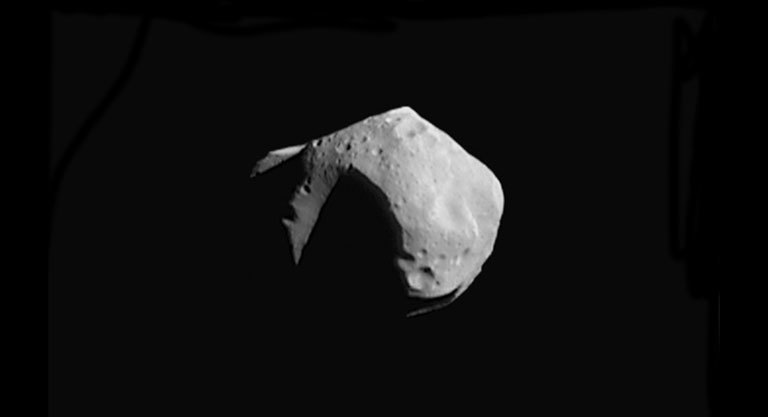
253 Mathilde
Mathilde is a C-type asteroid that was discovered by Austrian astronomer Johann Palisa at Vienna Observatory on 12 November 1885. It has dimensions 66 × 48 × 46 km, and an orbit semi-major axis distance of 2.6484 AU and eccentricity of 0.265. Mathilda has a notably slow rate of rotation, requiring 17.4 days to complete a 360° revolution about its axis. Mathilde was visited by the NEAR Shoemaker spacecraft during June 1997, on its way to asteroid 433 Eros, passing within about 1200 km of the asteroid at a relative speed of 9.93 km/s.
C/1996 B2 (Hyakutake)
C/1996 B2 Hyakutake is a long-period comet. Before its most recent passage through the Solar System, its orbital period was about 17,000 years, but the gravitational perturbation of the giant planets has increased this period to 70,000 years. It was the first comet that had X-ray emission.