Cassini Orbiter
Description
The Cassini Orbiter's mission consists of delivering a probe, called Huygens, to Titan, and then remaining in orbit around Saturn for detailed studies of the planet and its rings and satellites.
Identifier (LID)
urn:nasa:pds:context:instrument_host:spacecraft.co
Version
1.3
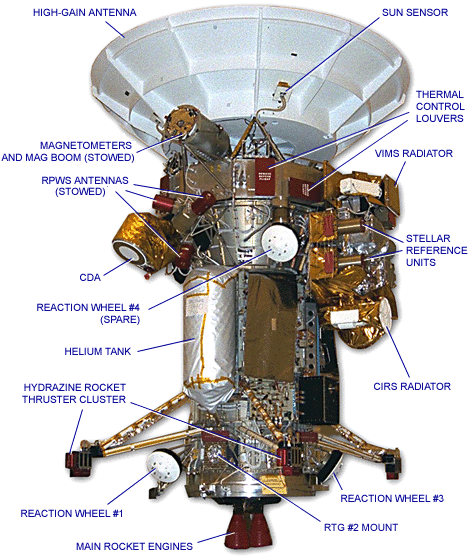
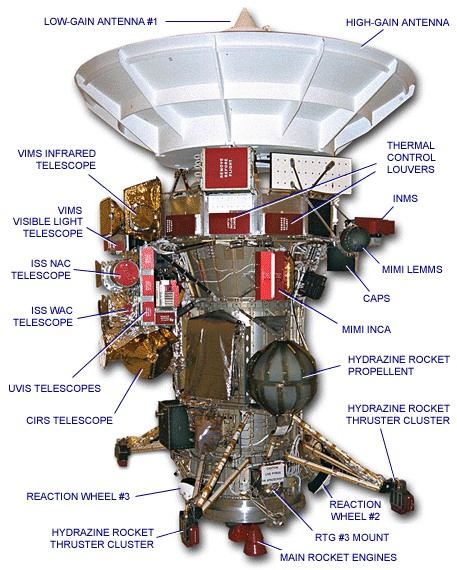
The Cassini instruments fall into three categories: Optical Remote Sensing, Radio Instrument, and Fields and Particles Instrument. Each group of instruments is listed below. More information is listed in the Instrument tab.
Optical Remote Sensing instruments
| Instrument or Detector | Wavelength Range |
|---|---|
| UVIS - Ultraviolet Imaging Spectrograph | |
| Extreme ultraviolet (EUV) | 563–1182 Å |
| Far ultraviolet (FUV) | 1115–1912 Å |
| High-Speed Photometer (HSP) | 1150–1990 Å |
| Hydrogen Deuterium Absorption Cell (HDAC) | 1150–2400 Å |
| ISS - Imaging Science Subsystem | |
| Narrow-Angle Camera (NAC) | 200–1050 nm |
| Wide-Angle Camera (WAC) | 380–1050 nm |
| VIMS - Visible and Infrared Mapping Spectrometer | |
| Visible (VIS) | 0.35–1 µm |
| Infrared (IR) | 0.85–5.1 µm |
| CIRS - Composite Infrared Spectrometer | |
| Focal plane array 1 (FP1) | 17–1000 µm |
| Focal plane array 3 (FP3) | 9–17 µm |
| Focal plane array 4 (FP4) | 7–9 µm |
UVIS - The Ultraviolet Imaging Spectrograph was a composite instrument consisting of two moderate-resolution spectrographs, a High-Speed Photometer (HSP) and a Hydrogen Deuterium Absorption Cell (HDAC) to measure hydrogen/deuterium ratios.
ISS - The Imaging Science Subsystem consisted of two fixed-focal length imaging cameras. The higher-resolution Narrow Angle Camera (NAC) and lower-resolution Wide Angle Camera (WAC) were both equipped with a dual set of filter wheels which allowed for color imaging from the ultraviolet, across the visible portion of the electromagnetic spectrum and into the near-infrared.
VIMS - The Visible and Infrared Mapping Spectrometer was designed to generate spectral maps of the Saturn system at visible and near-infrared wavelengths. It was also frequently used to record the occultation of stars by Saturn and its moons, as well as by Saturn's rings.
CIRS - The Composite Infrared Spectrometer was used for the investigation of the Saturn system in the mid to far infrared range. CIRS used three separate detectors which can be combined to cover a wavelength range from 7µm to 1 mm.
Radio Instruments
RADAR - The Radio Detection and Ranging instrument was a multimode Ku-band (13.78 GHz, 2.17 cm) radar instrument onboard Cassini. RADAR's primary goal was to pierce Titan's thick veil of smog and aerosols to map its surface.
RSS - The Radio Science Subsystem was used to probe the Saturn system at a number of different radio frequencies. Unlike the other science instruments onboard the Cassini spacecraft, the radio science experiment included not only the components scattered around the spacecraft but the large, Earth-based radio antennae of the Deep Space Network (DSN) that received the signals transmitted by RSS as well.
Fields and Particles Instruments
| Instrument or Detector | Energy or Mass Range |
|---|---|
| INMS - Ion and Neutral Mass Spectrometer | Mass Range |
| Ion and Neutral Mass Spec (Open source) ions | 1–99 Da Mass resolution: 1 Da |
| CAPS - Cassini Plasma Spectrometer | Energy Range |
| Ion Mass Spectrometer (IMS) | 1–50280 eV/e- |
| Electron Spectrometer (ELS) | 0.5–28750 eV/e- |
| Ion-Beam Spectrometer (IBS) | 1–49800 eV/e- |
| MIMI - Magnetospheric Imaging Instrument | Energy Range |
| Low-Energy Magnetospheric Measurements System (LEMMS) Forward Electrons | 0.1–0.884 MeV |
| LEMMS Reverse Electrons | 0.1–5 MeV |
| LEMMS Forward Ions | 0.03–18 MeV |
| LEMMS Reverse Ions | 1.6–160 MeV |
| Charge-Energy-Mass-Spectrometer (CHEMS) | 3–220 keV/e- |
| Ion and Neutral Camera (INCA) | 7–3000 keV/nuc |
| CDA - Cosmic Dust Analyzer | Energy Range |
| Dust Analyzer (DA) | Grain charge detection limit 1 fC Mass resolution: M/ΔM ~ 30 |
| High Rate Detector (HRD) | Count rates up to 104 m/s |
CAPS - The Cassini Plasma Spectrometer was comprised of a triumvirate of distinct sensors intended to study the full variety of plasma phenomena in the Saturn system, producing comprehensive all-sky mass-resolved measurements.
CDA - The Cosmic Dust Analyzer consisted of two instruments that detect incoming particles: the High Rate Detector (HRD) and the Dust Analyzer (DA). These co-aligned instruments were mounted on a turntable that allowed them to articulate.
INMS - The Ion and Neutral Mass Spectrometer was capable of determining the chemical, elemental and isotopic composition of the gaseous and volatile components of neutral particles and low energy ions in key regions of the Saturn system. The primary focus of the INMS was on Titan's upper atmosphere and its interaction with the surrounding magnetospheric plasma.
MAG - The Cassini Magnetometer (MAG) measured the three vector components and magnitude of the magnetic field in Saturn's magnetosphere and interplanetary space.
MIMI - The Magnetosphere Imaging Instrument was built to take global images and in-situ measurements of Saturn's magnetosphere. Its three separate sensors—the Ion and Neutral Camera (INCA), the Low Energy Magnetospheric Measurements System (LEMMS) and the Charge-Energy-Mass-Spectrometer (CHEMS)—provided data that allows scientists to investigate how Saturn's magnetosphere interacts with the solar wind, Saturn's atmosphere and Saturn's retinue of satellites, especially Titan, as well as study the overall configuration and dynamics of the Saturnian magnetosphere.
RPWS - The Radio and Plasma Wave Science instrument on the Cassini spacecraft was designed to study radio emissions, plasma waves, thermal plasma, lightning, and dust throughout the Saturnian system. It is composed of seven separate sensors: an electric field detector composed of three ten-meter long orthogonal antennas, a Langmuir probe for measuring electron density and temperature and a wave magnetic field antenna assembly which consists of three orthogonal search coils.