Cassini Composite Infrared Spectrometer
Description
The Composite Infrared Spectrometer (CIRS) on Cassini is designed to measure infrared emissions from atmospheres, rings, and surfaces over a wavelength range between 7 and 1000 micrometers. Its objectives for Saturn and Titan are to: (1) map the global atmospheric temperature structure; (2) map the global atmospheric gas composition; (3) ascertain global atmospheric haze and cloud distributions; (4) gather information on atmospheric energetic processes; and, (5) search for new atmospheric molecular species. Additional goals are to: (6) map global surface temperatures at Titan; and, (7) to determine the thermal characteristics and composition of Saturn's rings and icy satellites. To accomplish these goals, CIRS consists of a 50.8 cm Cassegra... ...Show More
Identifier (LID)
urn:nasa:pds:context:instrument:cirs.co
Version
1.0
Final Summary of Science Objectives and Results
CIRS Space Science Reviews Publication
See
Volume 1-Mission Overview, Science Objectives and Results
for full science report. The technical report is in other volumes archived at the Jet Propulsion Lab.
Mission Science Highlights and Science Objectives Assessment
provides a brief overview of the mission
- Map the thermal structure and composition of the atmospheres of Saturn and Titan
- Search for new molecular species in the atmosphere of Saturn
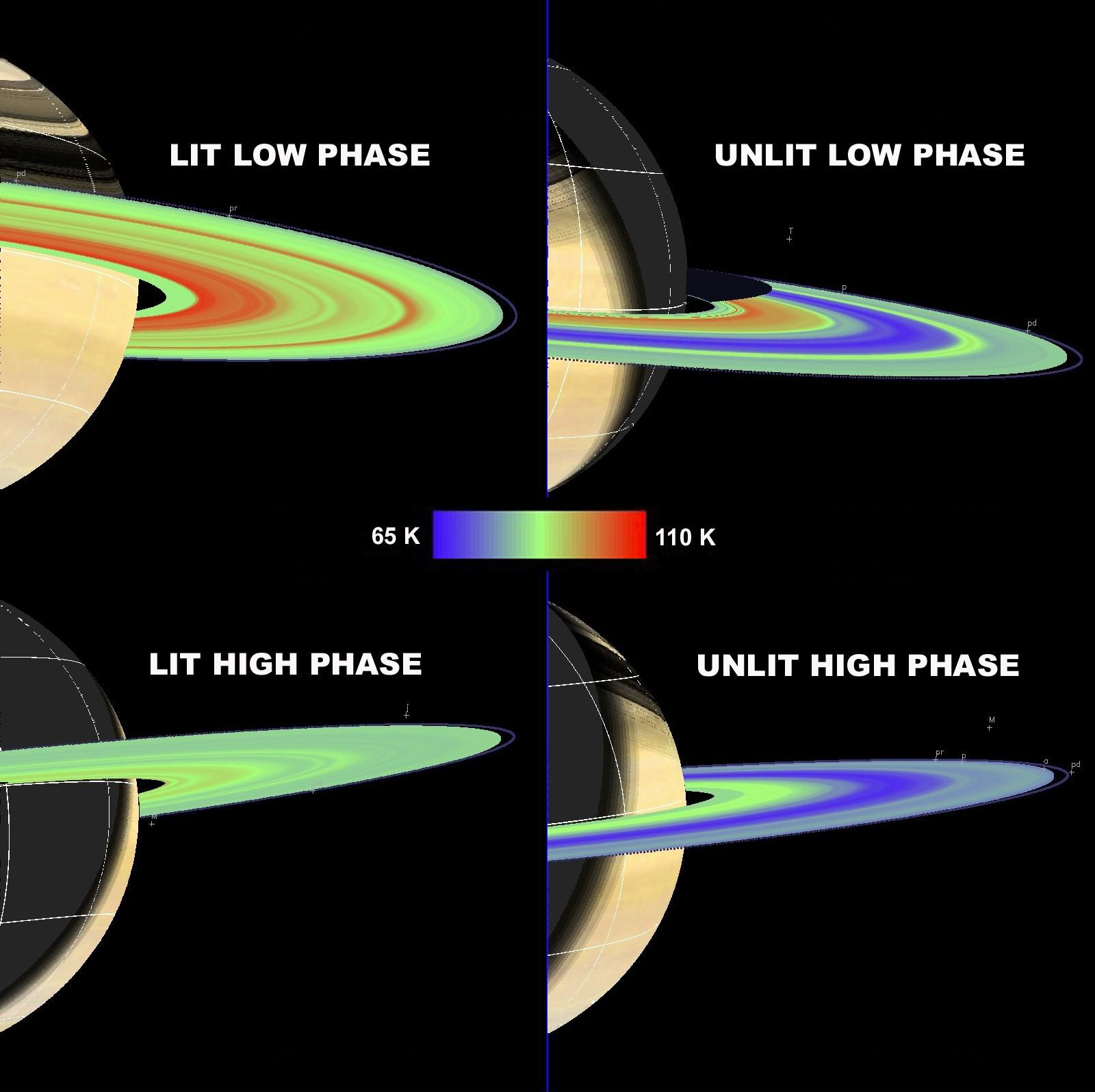
- Investigate the thermal structure of Saturn's main rings
- Determine the composition and size distribution of the particles that comprise Saturn's main rings
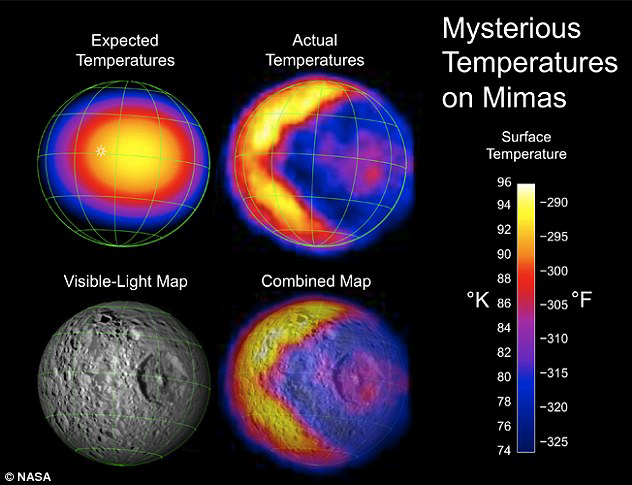
- Map the temperature and composition of Titan and Saturn's icy satellites
- Determine the subsurface regolith structure of Saturn's icy satellites
- Search for any seasonal variability among the physical properties in the components of the Saturn system
CIRS detectors:
- Polarizing interferometer: Far-IR on FP1 (Focal Plane Array 1)
- Michelson interferometer: Mid-IR on FP3 and FP4
- See the table below for the spectral ranges detected by each Focal Plane Array
| General Specifications | |||
|---|---|---|---|
| Telescope Diameter (cm) | 50.8 | ||
| Instrument Temperature (K) | 170 | ||
| Interferometers | Far-IR | Mid-IR | |
| Type | Polarizing | Michelson | |
| Spectral Range (cm-1) | 10–600 | 600–1400 | |
| Spectral Range (µm) | 17–1000 | 7–17 | |
| Spectral Resolution (cm-1) | 0.5–15.5 | 0.5–15.5 | |
| Integration time (s) | 2–50 | 2–50 | |
| Focal Plane Arrays | FP1 | FP3 | FP4 |
| Spectral Range (cm-1) | 10–600 | 600–1100 | 1100–1400 |
| Spectral Range (µm) | 17–1000 | 7–9 | 9–17 |
| Detectors | Thermopile | PC HgCdTe | PV HgCdTe |
| Pixels | 2a | 1 x 10 | 1 x 10 |
| Pixel FOV (mrad) | 3.9 | 0.273 | 0.273 |
| Peak Detectivityb (cm Hz1/2 W-1) | 4 x 10⁹ | 2 x 10¹⁰ | 5 x 10¹¹ |
a
Single FOV, two polarizations.
b
Detectivity, a measurement of detector performance sometimes referred to as D*, is equal to the square root of the product of the detector area and frequency bandwidth divided by the noise-equivalent power
* Values taken from Table I of Flasar
et al.
(2004) in
Space Science Review
- Cassini infrared Fourier spectroscopic investigation. Proc. SPIE 2803, 162-177 (1996)by Kunde, V. G., et al.
- Exploring the Saturn system in the thermal infrared: the composite infrared spectrometer. Space Sci. Rev. 115, 169-297 (2004) by Flasar, F. M., et al.
- The Composite Infrared Spectrometer (CIRS) on Cassini. Applied Optics, 56, 5274 by Jennings, D. E., et al. (2017).
CIRS Data
Data Search Tools
- The Event Calendar is an interactive event-finding tool that can be used to search for data associated with particular events.
- The Master Schedule is a time-ordered listing of observations by all instruments. This may help find data based on particular events.
Browse Raw Data Products
- Links to raw data products along with reference tables to aid in finding archived data files related to observations of Saturn, moons, and other targets.
- The folders within the link are formatted as 'cocirs_yymm' where 'yymm' indicate the year and month.
- Users should know when the data of interest was taken because data products are stored in the directories chronologically by the date of acquisition.
- Links to raw data products along with reference tables to aid in finding archived data files related to observations of the Jovian system.
- The folders within the link are formatted as 'cocirs_yymm' where 'yymm' indicate the year and month.
- Users should know when the data of interest was taken because data products are stored in the directories chronologically by the date of acquisition.
Derived Data Products
- The CIRS team has produced image cubes from observations of Saturn, Titan, and Saturn's icy satellites and its other moons.
Selecting Data Products
| Target Notebooks |
|---|
| Rings |
| Titan |
| Saturn |
| Icy Satellites and Other Moons |
The
is an interactive event-finding tool that can be used to search for data associated with particular events.
Analyzing CIRS Data
- Data Product Software Interface Specification Document - Describes the format and content of the CIRS Time Sequential Data Record (TSDR) products.
- Reaction Wheel Assembly (RWA) Interference Plots - At specific rotation rates, the RWAs would interfere with the CIRS scanning mechanism, compromising the data. The plots indicate when such interferences occurred.
- Thermal Analysis Plots - Documents the focal plane assembly temperature during periods when CIRS was taking data.
- Data Processing/Calibration Routines - For those wishing to get into the nitty-gritty of CIRS data handling. (in preparation)
- Vanilla Source Code - The database utility used by the CIRS team to interact with the CIRS dataset.